

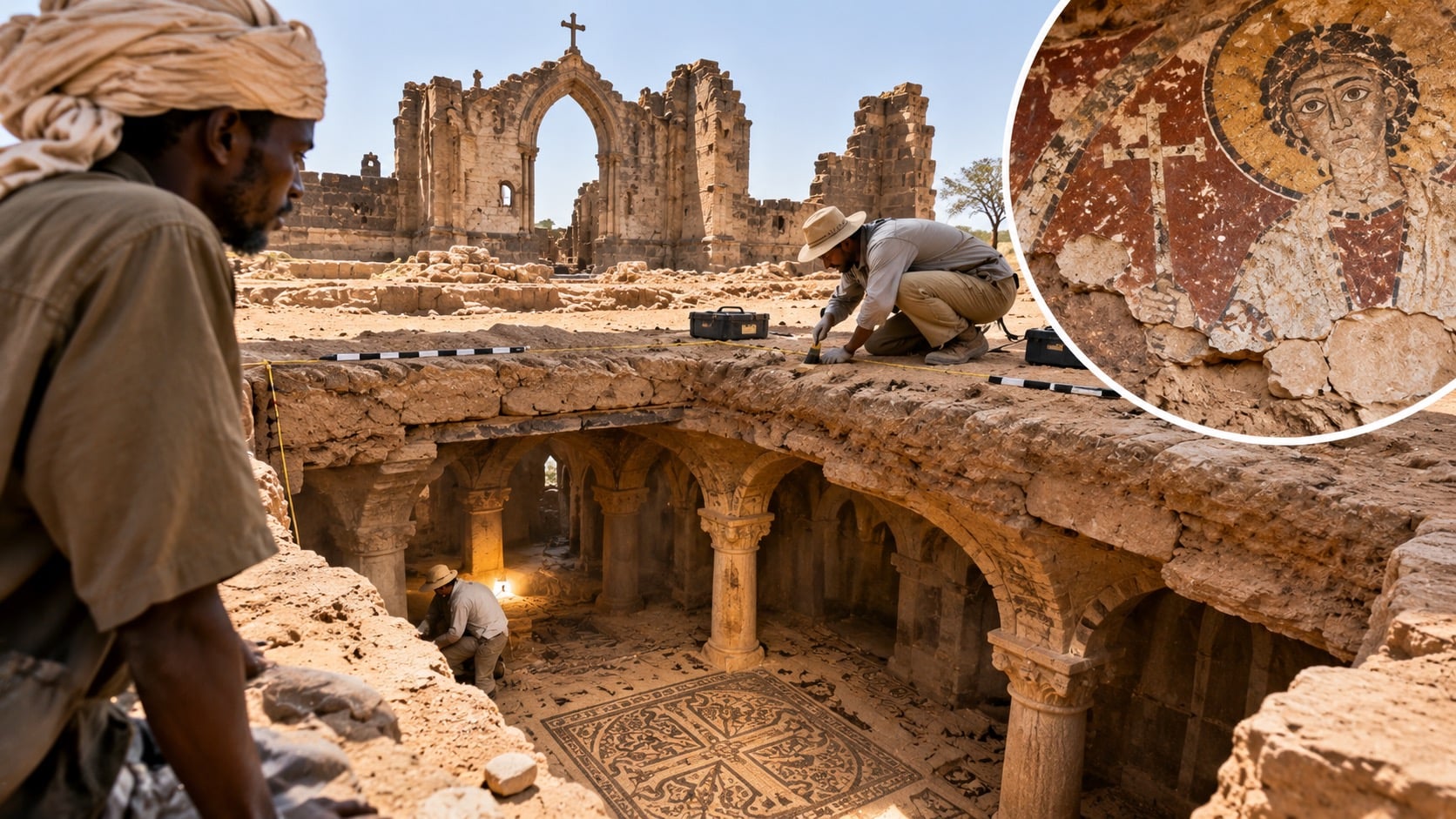
Archaeologists have reached the original floor of the Great Church of Jesus at Old Dongola, which they say may be larger than the White House. Sudan’s culture ministry says the discoveries come from the 2025 field season.
Archaeologists have uncovered the original floor of a monumental medieval cathedral in northern Sudan, revealing the scale of what is probably the largest church in medieval Nubia. A Polish-Sudanese mission found a staircase with 11-metre (36ft) high walls that led down to the floor of the Great Church of Jesus in the ancient city of Old Dongola. “This was a building larger than the famous White House… and we are planning to excavate it,” said Artur Obłuski, head of the mission and director of the Polish Center of Mediterranean Archaeology. The church was first found in 2021, but most of it remains buried.
The scale of the building
Old Dongola lies on the eastern bank of the Nile, about 160km (100 miles) south-east of modern-day Dongola, and is known for its many ancient churches. The staircase is the only place where the team has reached the floor. Mr Obłuski said archaeologists estimate the church measured about 47 metres (154ft) wide and 57 metres (187ft) long. University of Warsaw researchers put its original height at about 21 metres, equivalent to a six- or seven-storey building. An earlier estimate in 2021 gave a width of about 26 metres and an apse of about 6 metres in diameter. The final dimensions have not been settled, and the mission says its measurements, especially the overall length and height, remain provisional.
The walls are so well preserved that archaeologists must dig much deeper than usual, using specialist techniques and extra resources, Mr Obłuski said. The next field season is expected to establish the full size. Archaeologists also found buttresses reinforcing the main church’s apse, which show how its monumental eastern end was engineered.
Mr Obłuski called it the largest and most important church in medieval Makuria, one of three kingdoms that emerged along the middle Nile after Christian missionaries arrived in the sixth century. He compared it to Hagia Sophia in Istanbul, built by the Byzantine Emperor Justinian in 537. “In the history of architecture, certain buildings emerge that, to use a modern term, become trendsetters,” he said. “Hagia Sophia in Constantinople, modern-day Istanbul, is certainly one such example. The Great Church of Jesus appears to be a natural candidate for such a role in Nubia, and perhaps even in this part of Africa.”
A second church and new inscriptions
University of Warsaw archaeologists identified another place of worship on the upper floor of an extension beside the main structure. Only about a metre of its walls survives, but it was richly decorated with religious paintings. So much painted plaster was recovered from collapsed material that the fragments fill six large shelving units, though only small portions of the paintings remain on the walls.
Fragments from the smaller church carry Greek biblical odes, or canticles, a previously unidentified category of biblical text at Old Dongola, where Psalms had dominated earlier finds. Dr Agata Deptuła, the expedition’s specialist in ancient inscriptions, identified one fragment from the Prayer of Hannah, the mother of the prophet Samuel. The Greek letters are about five millimetres high and were written in a carefully executed book hand.
Was this the real cathedral?
Mr Obłuski suggests this church, inside the city walls, may have been the cathedral, and that a different church outside the walls, long regarded as the city’s cathedral, may have been misidentified. “We will probably have to revise our understanding of the role of that building and ask what its actual function was, if it was not a cathedral,” he said. Archaeology Magazine reported that its size and importance suggest it could have been the seat of the Bishop of Dongola, one of the highest-ranking Christian figures in medieval sub-Saharan Africa, though that is provisional.
A separate church linked to King David, dated to the 13th century, was found beside the main structure in 2023. Unlike the upper-storey church, much of its painted decoration survives. Historical Arabic accounts connect the Great Church of Jesus with a campaign by King David against Egypt, including attacks on Aswan and the Red Sea port of Aidhab, and archaeologists have asked whether a senior church leader may have encouraged the conflict. That remains an interpretation and not an established conclusion.
Sudan’s response
Khalid Al-Eisir, Sudan’s Minister of Culture, Information, Antiquities and Tourism, said on 10 November that the government would issue a clarification about claims in international and local media. Sudanese reporting cited specialists who said both the identification as the Great Church of Jesus and the description of the building as a cathedral are hypotheses needing further research. Questions were also raised about the timing of the excavations and which Sudanese authorities supervised them.
In a statement on 11 November, issued through the National Corporation for Antiquities and Museums, the ministry said the widely publicised discoveries came from the 2025 field season, not new excavations in November 2026, and that fieldwork continues in 2026. It said the mission operates under official permission and supervision, as part of decades of scientific cooperation between Sudanese heritage authorities and the University of Warsaw. The ministry welcomed the discoveries, saying they help explain the history of Christianity in Nubia and the architectural, artistic and religious development of its kingdoms.
Protecting the site
Old Dongola suffered its worst flooding since 1988 in autumn 2024, which damaged the protective roofs over excavated remains. Before work resumed, the expedition worked with the Faculty of Civil Engineering at Warsaw University of Technology on conservation and protective measures.
The project also supports local people. Polish Aid funding from the Polish Ministry of Foreign Affairs paid for a solar power installation that helps supply Nile water to about 10,000 residents, with the electricity powering pumps for homes and farmland. Eight water-pressure booster stations have been equipped to serve homes on higher ground, where Sudan’s conflict had cut off supplies. Local residents have formed an association to help protect Old Dongola, working with archaeologists and the antiquities authorities, and workshops train community members in heritage preservation.
The excavations are supported by the European Research Council-funded Afropolis Tungul project, which studies the city’s development from the fourth to the 15th centuries, and by a Polish National Science Centre project, Kyriakós oíkos?, on the changing use and meaning of Nubian churches. Mr Obłuski said the church could eventually become a major tourist attraction for Sudan’s antiquities authorities, though no opening date has been announced.
