

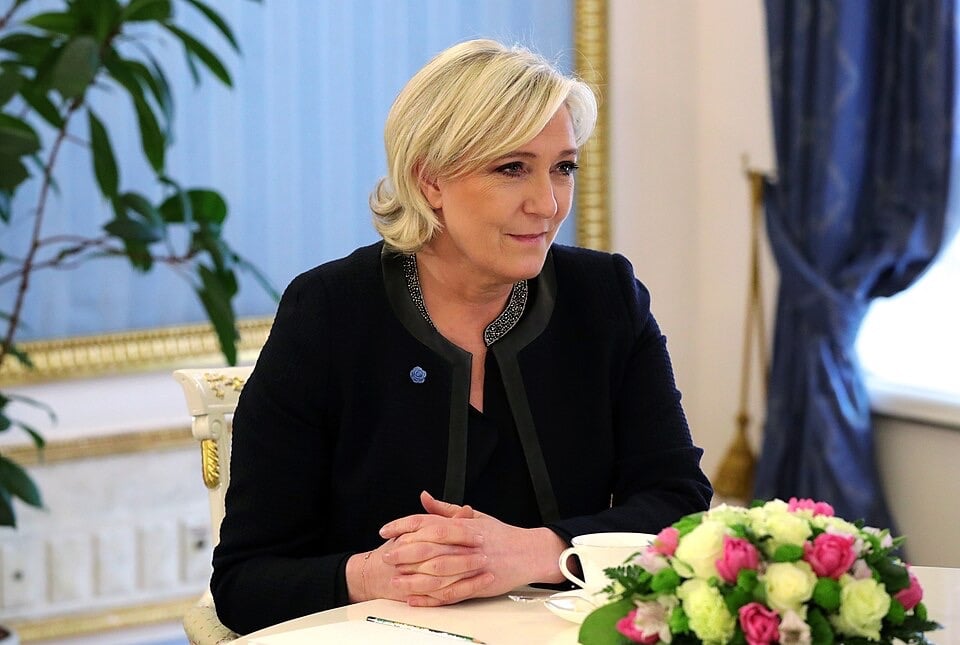
France goes to the polls in April 2027 with Marine Le Pen’s Rassemblement National holding a commanding lead, as voters weary of political chaos and rising immigration concerns look increasingly likely to hand the French presidency to the populist right for the first time.
France will vote in the first round of its next presidential election on Sunday 18 April 2027, with a run-off on Sunday 2 May 2027 should no candidate secure an outright majority. Emmanuel Macron, in office since 2017, is constitutionally barred from seeking a third consecutive term, guaranteeing the country its first new president in a decade. With months still to go, one fact already stands out clearly in the polling: Marine Le Pen and the Rassemblement National are comfortably ahead, and for the first time in French postwar history, the party looks capable of actually winning.
The RN’s commanding lead
An Ifop-Fiducial survey for LCI and Le Figaro, conducted on 7–8 July 2026 immediately after Le Pen confirmed her candidacy, put her on 36% of first-round voting intentions — more than double her nearest rival, former prime minister Édouard Philippe, on 19%. Jean-Luc Mélenchon trailed on 15%, with Raphaël Glucksmann on 9% and the Republicans’ Bruno Retailleau on 8%. A separate Toluna Harris Interactive poll for M6 and RTL taken the same week placed her between 34% and 36%.
More strikingly, Le Pen wins every run-off scenario tested. The Ifop poll had her beating Philippe 54%–46%, defeating Gabriel Attal 55%–45%, and crushing Mélenchon 70%–30%. This marks a genuine break from the pattern that blocked the RN in both 2017 and 2022, when a “republican front” of tactical voting united behind Macron to keep Le Pen out. That firewall now appears to be crumbling. Should Le Pen be unable to stand, party president Jordan Bardella is her designated substitute and polls almost identically — a May 2026 Elabe survey put him at 35–37.5% in the first round against her 34%, confirming the RN’s support transfers seamlessly between the two.
Why voters are turning to the RN
The reasons are not hard to find. Immigration and security dominate voter concerns, and the RN has owned both issues for years — a CNCDH survey cited by France 24 found 83% of RN supporters attribute rising insecurity primarily to immigration, a view shared by a growing share of the wider electorate. The cost-of-living crisis has further boosted the party’s appeal, with the RN positioning itself as the defender of ordinary households’ purchasing power and pledging to cut energy taxes.
Above all, voters appear simply exhausted by years of Parisian dysfunction. Since Macron dissolved parliament following the RN’s 2024 European election win, no governing bloc has held a majority, and a succession of prime ministers has collapsed in short order — Michel Barnier ousted in December 2024, François Bayrou gone by September 2025, and Sébastien Lecornu’s first government lasting a mere 27 days, the shortest in modern French history, before he narrowly survived two no-confidence votes. Macron himself is now deeply unpopular: an Elabe barometer for Les Échos published on 2 July 2026 recorded confidence in him at just 23%, his lowest reading since taking office in 2017, with an Ifop poll the same week finding 71% of voters expressed outright distrust in him. Against that backdrop, the RN’s long strategy of “dédiabolisation,” softening its image and shedding some of its more radical past positions, has paid dividends, with Bardella in particular making major inroads among younger voters through a huge TikTok following.
A more moderate RN?
Supporters of the party argue that what’s on offer in 2027 is a considerably more responsible and mainstream RN than the one voters rejected in previous elections. The party has dropped its previous calls for “Frexit” and withdrawal from the euro, instead proposing to reform the EU from within into a looser “union of nations” with reduced supranational powers. Bardella has gone out of his way to reassure European partners, describing Franco-German relations as “the foundation of Europe,” explicitly distancing the RN from Germany’s AfD by calling its positions “incompatible with our principles,” and pledging to maintain France’s NATO commitments on its eastern flank against Russia. For voters concerned that a Le Pen presidency might mean instability abroad, this is a markedly softer and more institutional posture than the party’s older Euroscepticism.
Le Pen’s legal battle
Any account of this race has to reckon with Le Pen’s ongoing legal troubles. In March 2025, a Paris court convicted her in the long-running European Parliament “fake jobs” case, handing her a four-year sentence and a five-year ban from public office that initially appeared to end her candidacy outright. On appeal, however, the Paris Court of Appeal upheld the conviction on 7 July 2026 but reduced the ineligibility period to 45 months, with 15 months already served, restoring her eligibility to stand. She confirmed her candidacy on TF1 that evening, declaring: “I am a candidate in the presidential election. I will not change my mind.”
Le Pen is now appealing to the Court of Cassation, France’s highest court, which Reuters reported could rule “by early April 2027 at the latest, before the presidential election” — though some analysts, including Sciences Po’s Luc Rouban, believe a ruling may not come until after the vote. Critically, the pending appeal suspends her sentence, meaning she can campaign freely without the electronic tag the original ruling imposed.
The rest of the field
The centrist camp, once Macron’s political home, is fractured between two of his former prime ministers, Édouard Philippe and Gabriel Attal, with Justice Minister Gérald Darmanin also circling. Analysts warn this rivalry risks splitting the centrist vote badly enough to hand a run-off spot to Mélenchon instead — a scenario polling suggests would actually be the most favourable possible outcome for Le Pen. On the left, a unity primary is scheduled for 11 October 2026, though La France Insoumise and the Socialists look set to run separate candidates regardless, further fragmenting Macron’s would-be successors. Former prime minister Dominique de Villepin has also entered the race as a self-styled “unifying” figure, though he remains stuck in the mid-single digits.
What critics say
Opponents of an RN presidency raise several concerns. Macron ally Marc Ferracci has argued that what stands between Le Pen and the presidency “is not simply an electronic bracelet; it’s her moral compass,” pointing to her upheld conviction. Economists have also questioned the RN’s fiscal credibility, citing Bardella’s call in an interview with The Economist for the European Central Bank to buy French debt. Foreign policy analysts warn that an RN government pursuing nationalist positions on immigration and EU institutions could strain relations with Berlin and other partners, and point to Le Pen’s past sympathy for Vladimir Putin, including her recognition of Russia’s annexation of Crimea and past opposition to sanctions, as a continuing source of unease among allies, alongside her May 2026 revival of the idea of leaving NATO’s integrated command structure. Markets have also shown signs of nervousness, with the spread between French and German ten-year bonds hitting levels last seen during 2025’s government collapse and reminiscent of the 2012 eurozone debt crisis.
The historical backdrop
The scale of the RN’s current advantage becomes clear against recent electoral history. In the 2022 run-off, Macron still beat Le Pen comfortably, 58.5% to 41.5%, itself the best result ever recorded by the French far right. Two years later, in the June 2024 European elections, the RN topped the poll outright with 31.37%, more than double Macron’s list, triggering his snap parliamentary dissolution. Even in the legislative elections that followed, where tactical “republican front” withdrawals held the RN to third place in seats despite winning the most votes nationally, the underlying trend was unmistakable. With that firewall now looking far less reliable heading into 2027, and no centrist figure commanding anything like Macron’s 2017 or 2022 authority, the RN’s path to the Élysée looks more open than at any point in the party’s history.
