

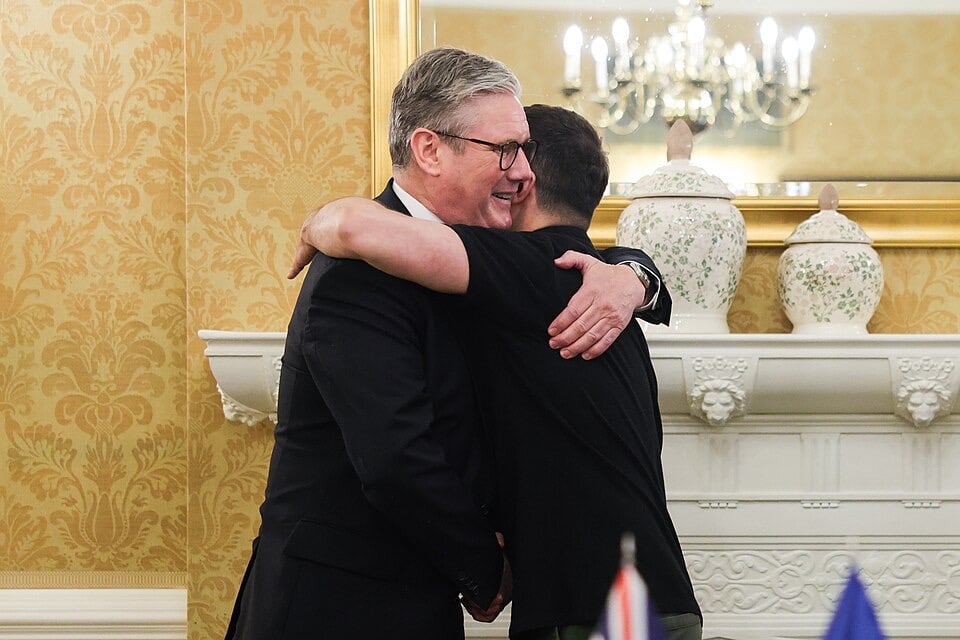
Sir Keir Starmer is set to travel to Kyiv today for a final summit with President Volodymyr Zelenskyy, just days before stepping down as prime minister, where he will tell his Ukrainian counterpart that Britain’s “cast iron support for Ukraine will endure” beyond his time in office. The visit will be Starmer’s third to the Ukrainian capital since becoming prime minister, and is intended to underline his role in backing Ukraine alongside fellow European leaders during his premiership.
Ahead of the trip, Starmer said: “When I became prime minister, I knew the UK must not simply stand with Ukraine in the moment but help build the foundations of its long-term security and success. That’s why we put the UK at the centre of a stronger Europe – investing more money into defence, leading the way in the warfighting technologies of the future, and doing everything we can to put Ukraine in the strongest possible position.” He added: “I am so proud of what Britain has contributed. That work will continue, and our cast-iron support for Ukraine will always endure.”
A pledge of continued military support
Starmer is expected to use the Kyiv visit to reaffirm Britain’s commitment to providing £3billion a year in military assistance to Ukraine “for as long as it takes,” framing the pledge as one that will outlast his own premiership. The two leaders are expected to discuss where allies need to focus their efforts next as the war, now into its fifth year, continues. Starmer is also set to highlight Britain’s role within the 34-nation Coalition of the Willing and its co-leadership of the Defence Contact Group, which coordinates international military donations to Ukraine.
Building on the Paris summit
The Kyiv trip follows closely on the heels of a summit in Paris, the final gathering of the Coalition of the Willing, a group Starmer helped establish alongside French President Emmanuel Macron to coordinate international support for Ukraine. At that summit, participating countries agreed to increase deliveries of air defence systems, interceptors and long-range capabilities to Ukraine, while stepping up economic pressure on Russia. Leaders also announced the creation of a new Anti-Ballistic Missile Coalition, aimed at building a shared European missile defence capability, with member countries voicing support for expanding Ukraine’s own air defence network.
Paris summit leaders also confirmed that the planned Multinational Force for Ukraine is ready to deploy once a credible ceasefire is reached, with military exercises planned in the coming months to test its readiness. NATO Secretary General Mark Rutte used the summit to press allies to keep increasing donations of air and missile defence systems, noting that NATO members have already pledged €70billion in military equipment, assistance and training for Ukraine this year, with a similar level of commitment expected in 2027.
A final act signing Britain into EU defence financing
While in Paris, Starmer signed the UK up to a €60billion EU defence loan scheme in one of his final acts as prime minister, a move intended to ensure British companies can fully benefit from military contracts placed by Kyiv. The Kyiv visit follows Britain’s formal accession to the EU’s €90billion Ukraine Support Loan scheme, which allows UK defence firms to bid for contracts financed through the programme, further deepening defence cooperation between Britain and the rest of Europe.
During the same Paris trip, Starmer became the first serving UK prime minister to receive France’s highest honour, the Legion d’Honneur, presented to him personally by Macron. In his remarks, Macron praised Starmer for “the commitments for obviously our country, but also the security of Europe, Ukraine, and the bilateral relationship.”
Fiftieth overseas trip caps a foreign-policy-heavy premiership
Today’s visit will mark Starmer’s 50th trip overseas in just over two years in office, a figure that reflects the extent to which international affairs have dominated his premiership, shaped by Donald Trump’s trade wars, the conflicts in Ukraine and the Middle East, and his efforts to reset Britain’s relationship with the EU following Brexit. Allies have pointed to the decision to make one final visit to Zelenskyy as evidence of Starmer’s personal commitment to Ukraine, and have credited him with helping reposition Britain on the world stage and within Europe more broadly.
During his final Prime Minister’s Questions on Wednesday, Starmer used an exchange with Conservative leader Kemi Badenoch, who praised his work on Ukraine and his relationship with Zelenskyy, to recall a key moment from his premiership. Starmer told the Commons he had been the first international leader to contact Zelenskyy following the Ukrainian president’s confrontation with Donald Trump in the Oval Office in early 2025, saying he had invited Zelenskyy to Downing Street shortly afterwards to demonstrate Britain’s continued backing.
Criticism over ‘never here Keir’
Despite the praise from allies, Starmer’s heavy focus on international affairs has also drawn criticism during his time in office, earning him the nickname “never here Keir” among critics. Some of his own parliamentary colleagues have suggested his attention to global matters came at the expense of his relationship with the parliamentary party and created difficulties on the domestic front. Starmer has pushed back against this characterisation, arguing that international and domestic issues cannot be separated, pointing to the impact of the war on fuel, energy and food prices felt by people across Britain. Speaking to the BBC earlier this month, he suggested his successor would likely need to dedicate a similar amount of time to global turmoil during their own time in office.
