

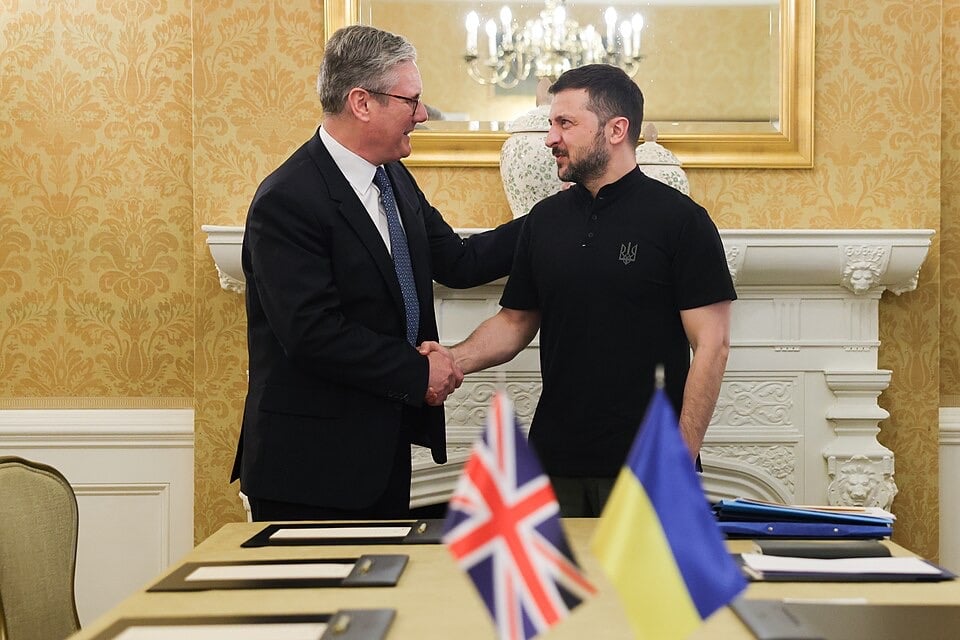
Sir Keir Starmer has signed Britain up to a new European missile defence coalition alongside nine other nations, including Ukraine, in a move aimed at building a coordinated shield against ballistic missile threats. The Prime Minister joined French President Emmanuel Macron and the leaders of Denmark, Germany, Italy, the Netherlands, Norway, Spain and Sweden at the Coalition of the Willing summit in Paris on Monday to formally establish what has been named the Integrated Anti-Ballistic Missile Coalition.
The agreement was struck at the Hôtel des Invalides, where Starmer was seen giving Macron a warm embrace as leaders gathered alongside roughly a dozen defence firms to press ahead with the initiative. In a statement, France’s presidency set out the coalition’s rationale: “We believe that the protection of Europe requires a global solution of integrated missile defence architecture to deter and defeat future missile threats — developed through collective effort, technological openness, and trusted industrial cooperation.” The statement added that the new coalition “will complement existing ballistic missile defence systems, including sovereign European solutions already acquired, or to be acquired by participating countries.”
Why the coalition matters for Ukraine
The initiative comes as Ukraine finds itself increasingly exposed to Russian ballistic missiles, with the country critically short of munitions for its own air defence systems. Over the past month, Ukraine has been largely unable to intercept ballistic missiles, which travel at several times the speed of sound, prompting Kyiv to appeal to allies for further supplies and to press Europe to collaborate on its own anti-ballistic air defence capability. Even as Russian strikes have intensified, Ukraine has stepped up its own drone attacks inside enemy territory, targeting oil facilities and weapons production in an effort to shift momentum on the battlefield.
Ukrainian President Volodymyr Zelensky attended a broader gathering of roughly 25 leaders as part of the wider Coalition of the Willing summit, which also focused on agreeing a common position that could be presented to Russia, alongside security guarantees intended to underpin any future peace settlement. Ahead of Monday’s talks, Zelensky said several countries were expected to formalise support for the Freyja project, Ukraine’s push to develop a lower-cost, European-backed alternative to the Patriot missile defence system. Following the announcement, he explained the thinking behind the initiative: “Our work on a joint system – Freyja – is not intended to replace existing systems. It is a way to supplement our defence, create a strong shield over the entirety of Europe, and do all of this faster and at a lower cost.”
What the coalition will focus on
According to officials, the ten participating countries will concentrate on joint procurement, industrial cooperation and the development of new missile defence technologies as part of a long-term effort to strengthen European security. A French presidency official said talks in Paris would also explore how to secure additional US-made Patriot interceptor missiles, alongside efforts to accelerate deployment of the Franco-Italian SAMP-T air defence system. Around a dozen European defence companies took part in the summit, including SAMP-T manufacturer Eurosam, along with Leonardo, Thales, Saab and Ukraine’s own Fire Point, as attendees discussed industrial cooperation and future production capacity.
Pressure mounts as Russian strikes continue
Monday’s summit followed closely on the heels of a NATO gathering intended to demonstrate transatlantic unity and sustained support for Ukraine. Russia has escalated its strikes on Kyiv and the surrounding region in recent weeks, with officials reporting that missile and drone attacks across Ukraine on Saturday alone left eight people dead and many more injured. Moscow maintains that it targets only sites of military relevance and denies deliberately striking civilians.
Squeezing Russia’s revenue streams
Beyond missile defence, leaders meeting in Paris also discussed measures to restrict Moscow’s sources of income, including efforts to disrupt Russia’s so-called “shadow fleet” — tankers operating under opaque ownership structures that have been used to circumvent international oil restrictions.
