

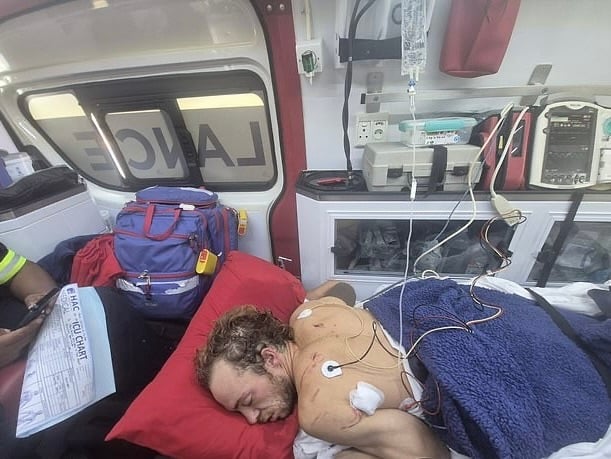
Samuel McKee, 31, was seriously injured in the Okavango Delta last September. He and his wife, Anna, have now spoken about the attack and the long recovery that followed.
Samuel McKee, 31, was gored by a hippo on his honeymoon in Botswana’s Okavango Delta, and his wife, Anna, also 31, says she punched the animal until it let go. The couple, from Washington state, were on a traditional mokoro canoe trip last September when they drifted away from their group and a hippo began charging. They have now described the ordeal, which left Mr McKee with life-threatening injuries, to the Cascadia Daily News. He survived after surgery in South Africa, and the pair have since found comfort in taking up pottery together.
The attack
After several days watching wildlife on safari, the McKees were offered a trip in a mokoro, a traditional canoe, to see plants on the flooded plains. They say the outing turned dangerous when they separated from the rest of the group and an aggressive hippo went for them.
“I saw this look in the guide’s eyes that I’ll never forget,” Mr McKee told the Cascadia Daily News. “It was just like sheer terror.”
The hippo struck him in the side. Mrs McKee watched as it threw her husband around. She said her fight-or-flight instinct took over. “I started screaming a very primal, animalistic noise of grief as one does when they’re seeing their love of their life get killed in front of their eyes, and I started running towards Sam,” she said. She waded through the water and punched the hippo with all her strength, and said she kept fighting it until it let go, fearing he would be gored to death in front of her.
Mr McKee knew he was badly hurt. He said he could see an organ protruding from his abdomen and could not feel one of his legs.
Waiting for rescue
Even once the animal had released him, the couple faced a dangerous wait for help from deep inside the reserve. Mrs McKee, driven by fear and adrenaline, contacted relatives at home and the US embassy and begged them to send emergency help. Her family arranged a medevac helicopter, which arrived after an agonising wait of several hours.
In total, Mr McKee went 13 hours without medical attention or painkillers. He was flown to a hospital in South Africa 18 hours after the attack and underwent major emergency surgery.
Recovery
When he woke, he found he had a transverse colostomy to bypass his colon, 20 staples in his abdomen, IVs in his neck and arms, and a feeding tube and ventilator. Despite the bite, the muddy water and blood and bile pooling in his abdomen, he avoided infection. His injuries included fractured vertebrae and ribs, a long cut on his left leg and a large hole in his back.
It was weeks before the couple could return to the US. Mr McKee began his recovery in Johannesburg and then continued in Seattle, where he started physical therapy. “I’m a very active person and have a lot of energy, so it was really hard for me mentally to be stuck in a bed all day,” he said.
Months passed before life began to feel anything like normal, as they dealt with the physical trauma and the memory of the attack. They found a sense of normality by taking up pottery together. Because of his weakened muscles, Mr McKee could use the wheel for only up to 15 minutes at first, but he began spending more time at it with his wife.
“It’s a pretty nice way to live, feeling like you were supposed to die, because it just makes you that much more grateful for every day,” he said.
