

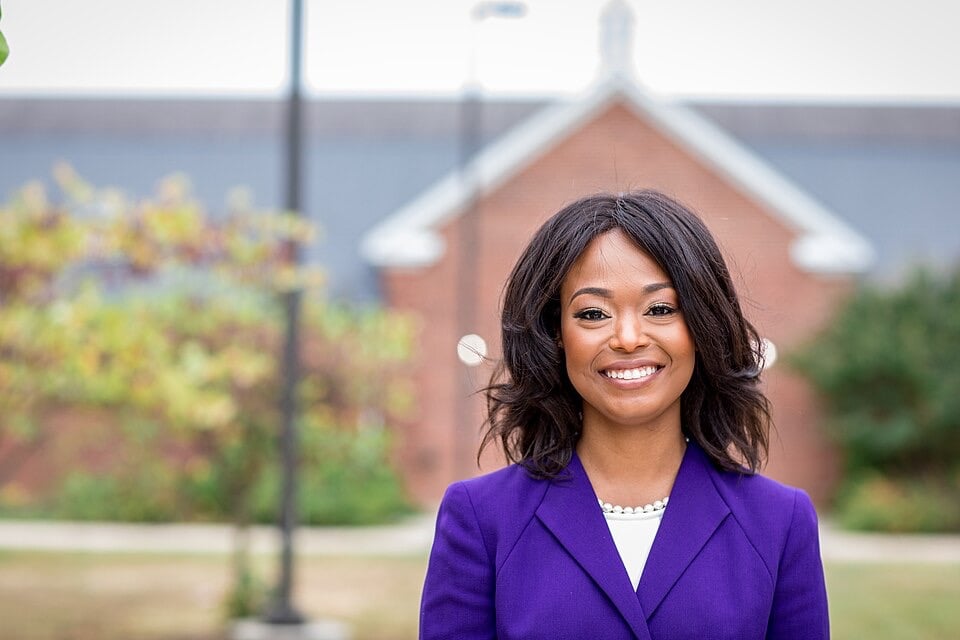
Washington DC is poised to elect a democratic socialist as its next mayor, on a direct collision course with Donald Trump, who has threatened to federalise the capital if voters choose a candidate he disapproves of.
With more than 60 per cent of votes counted in Tuesday’s Democratic primary, Janeese Lewis George was holding just above 50 per cent, with her main rival, former city council member Kenyan McDuffie, on 36 per cent. Because DC’s voter base is overwhelmingly Democratic — Kamala Harris won 90.3 per cent of the presidential vote there in 2024 compared to Trump’s 6.5 per cent — whoever wins the Democratic primary is effectively guaranteed to become the city’s next mayor. The last Republican to hold the post was Sayles Jenks Bowen, who served from 1868 to 1870, when the party was still associated with Abraham Lincoln.
Trump made no secret of his displeasure at the prospect of a Lewis George victory. “I wouldn’t like it,” he told reporters in the Oval Office on Thursday. “Maybe we take back Washington and run it on a federal basis. We won’t put up with it.” Lewis George, speaking to supporters at the Howard Theatre on U Street — part of the historic neighbourhood known as “Black Broadway” — fired back without naming the president directly. “If there was ever any doubt, let it now be laid to rest. It is the people of DC who elect the mayor of DC,” she said to cheers.
The contest offered DC Democrats a clear ideological choice: back Lewis George, cast in the mould of New York City’s Zohran Mamdani and representing the democratic socialist wing of the party, or support McDuffie, a more moderate figure backed by business and restaurant leaders who had spent several years as an independent before re-registering as a Democrat to mount his run. They chose to take the more confrontational path.
If Lewis George holds above 50 per cent, she wins the primary outright. Should she dip below, DC’s newly implemented ranked-choice voting system will redistribute votes from less popular candidates, though she remains in a strong position regardless. Mail-in ballots postmarked by election day are still being counted, which delayed results for hours after polls closed at 8pm on Tuesday.
Any move by Trump to strip DC of its self-governance would require an act of Congress. The District of Columbia Home Rule Act of 1973 gives DC residents the right to elect a mayor and city council, but because DC is a federal district rather than a state, its residents have no representation in Congress, and Congress retains ultimate authority over local laws and the DC budget. Republicans have historically used that power to intervene on issues including abortion funding, marijuana legalisation and gun restrictions.
A DC statehood movement has grown in response, with a Democrat-led House passing a statehood bill in 2021, though it stalled in the Senate amid widespread Republican opposition — largely because statehood would all but guarantee two Democratic senators and a Democratic House member.
Outgoing mayor Muriel Bowser, who served three terms and chose not to seek a fourth, navigated a delicate relationship with the Trump administration during its second term, making concessions including paving over the large Black Lives Matter street mural on 16th Street directly in front of the White House, and praising anti-crime initiatives while criticising immigration enforcement operations. Lewis George is unlikely to take the same accommodating approach.
