

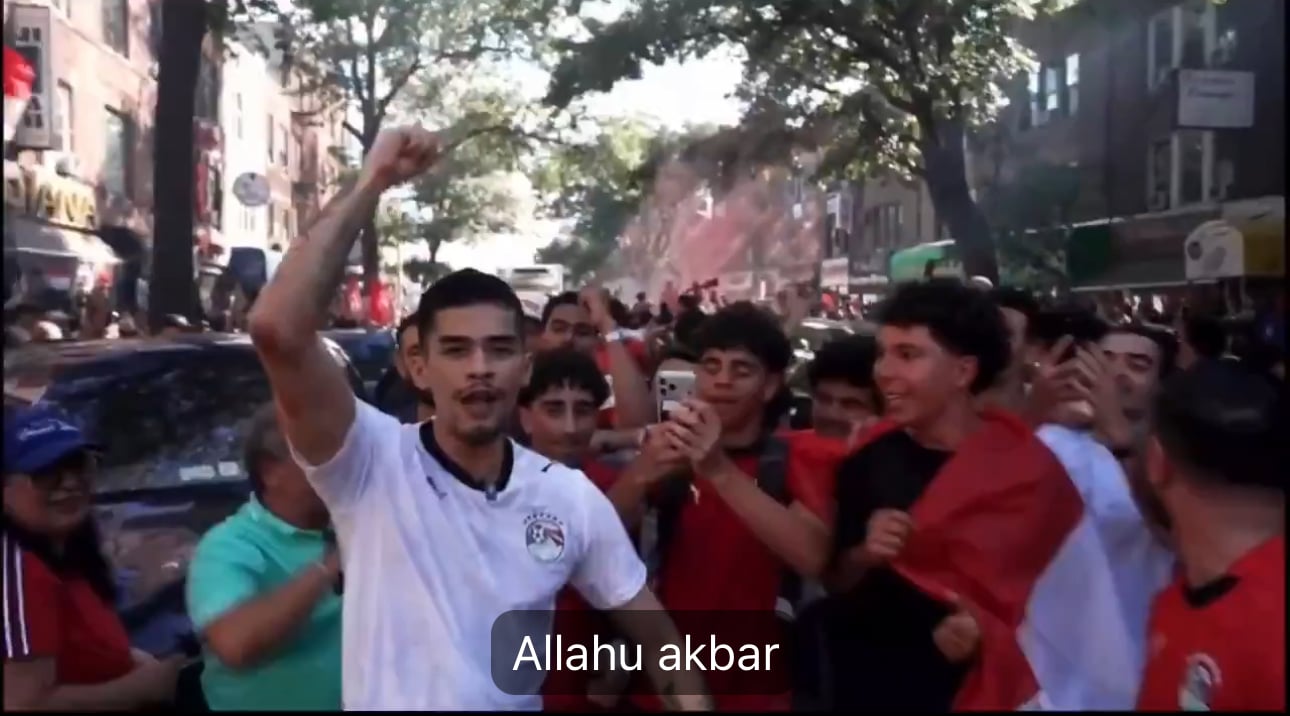
Streamer’s comments during World Cup celebrations in Queens divide opinion over faith, free speech and integration.A streamer’s comments made during World Cup celebrations in New York have triggered a heated online debate over religion and free speech, after he told cheering crowds that Islam would eventually reach “every household” in America.
The remarks were made by Nico Kenn De Balinthazy, better known online as Sneako, during celebrations in Astoria, Queens, on 3 July, following Egypt’s dramatic penalty shootout win over Australia in the Round of 32 of the 2026 FIFA World Cup. The match finished 1-1 before Egypt won 4-2 on spot-kicks, securing the country’s first-ever World Cup knockout victory. Thousands of Egyptian supporters gathered to celebrate in Astoria, an area home to one of the largest Egyptian and Arab communities in the United States and often referred to as “Little Egypt.”
Footage of the celebrations, widely shared across X, Instagram and YouTube, shows Sneako addressing the crowd and describing the neighbourhood as the “Islamic Republic of New Yorkistan.” He went on to say that “Islam will be in every household,” adding that he hoped “the whole world will become Muslim.” Members of the crowd can be heard responding with chants of “Allahu Akbar.”
The clips quickly drew a polarised response online. UFC fighter Josh Hokit was among those who criticised the comments, publicly challenging Sneako to a sparring match and accusing him of stirring division. Other critics argued the language came across as triumphalist, and questioned whether such rhetoric risked feeding wider anxieties about religious extremism and cultural integration.
Others defended the streamer, framing his comments as an expression of religious enthusiasm rather than any form of hostility. Some supporters drew comparisons with Christians who express hope for the worldwide spread of their faith, arguing that aspirations for global conversion are a common feature across many religious traditions rather than something unique to Islam.
Sneako himself has defended the remarks as protected religious speech under US law, arguing that similar hopes expressed by Christians or followers of other Abrahamic faiths do not typically attract the same scrutiny. The controversy comes against the backdrop of his increasingly public embrace of Islam in recent years, during which he has documented his religious practice online and taken part in discussions with prominent Muslim commentators, including Mohammed Hijab.
Beyond the reaction to Sneako specifically, commentators have noted that the episode taps into broader and long-running debates in the US around immigration, religious identity and multiculturalism. Research from the Pew Research Center indicates that Muslims remain a relatively small proportion of the overall US population, though their numbers have grown through immigration, higher birth rates and religious conversion, with significant communities concentrated in cities such as New York.
Legal experts have also pointed out that expressing religious beliefs, including hopes for the spread of a particular faith, is generally protected under the First Amendment, provided such speech does not incite violence or otherwise break the law.
Egypt’s win means the team progresses to the Round of 16, where they are set to face Argentina — ensuring their historic World Cup run, and the celebrations surrounding it, remain in the spotlight.
