

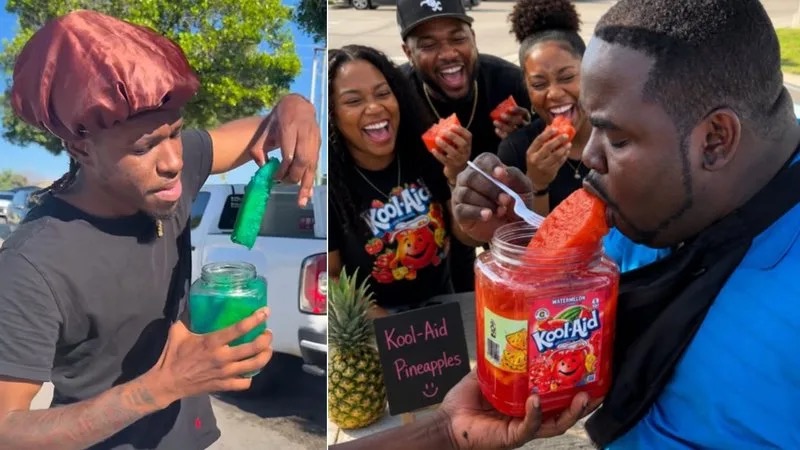
A new food trend is sweeping TikTok, Instagram and X this summer — and health experts are already sounding the alarm. Kool-Aid pineapples, neon-bright sugar-soaked fruit snacks being sold from the backs of cars and going viral in millions of reaction videos, have become one of the most talked-about food crazes of 2026. But behind the vivid colours and infectious enthusiasm lies a sugar bomb that nutritionists are warning could be seriously harmful.
The concept is simple. Take a large jar of pineapple spears — typically between 35 and 48 ounces — drain some of the juice, mix it with a packet of unsweetened Kool-Aid powder and a generous amount of added sugar, pour everything back into the jar and refrigerate for several hours until the fruit absorbs the colour and flavour. The result is pineapple that has turned deep red, electric blue or neon pink — and which many people describe as tasting somewhere between fruit and candy.
The trend was popularised by Instagram user Silly Willie, who sells his “Pineapple Dreamz” Kool-Aid pineapples out of the back of his car and is widely credited with starting the craze in mid-April 2026. Since then, numerous creators have started selling their own versions, supposedly to great success.
The moment that sent the trend into the stratosphere came on 29 May, when a young man named Bubba Harrelson was recorded trying a jar of Kool-Aid pineapples and declared “Dat bih gah” after chomping on one of the spears. The original video racked up over 30 million views in just three days, spawning an avalanche of memes and reaction videos that kept the trend at the top of social media feeds for days. Harrelson subsequently told content creator Lil Tyke in a follow-up interview: “Gotta whole bunch of fame, a whole bunch of people liking my sh*t.”
The viral appeal is obvious — the bright colours make it built for social media, and the simple recipe means almost anyone can recreate it at home. Sellers have been filming customers’ reactions and posting them online, with the format proving irresistible to audiences across TikTok, Instagram Reels and X.
But the health warnings are significant. The sugar content of a full viral jar adds up to around 320 to 350 grams of total sugar — roughly equivalent to nine 12-ounce cans of Coca-Cola. Health experts have warned the trend can pack as much sugar as 20 to 35 Krispy Kreme glazed donuts in a single jar.
Critics have pointed out that the recipe takes fruit — which is usually viewed as a healthier snack — and turns it into something much closer to candy. Others have raised wider concerns about viral high-sugar food trends, especially when they are marketed as casual snacks rather than occasional treats. The Kool-Aid packet itself is not the main issue — unsweetened Kool-Aid drink mix generally contains little to no sugar on its own — but most viral recipes call for significant amounts of added sugar on top of the natural sugars already present in the pineapple and its syrup.
The trend itself is not entirely new in concept. Kool-Aid pineapples are based on Kool-Aid pickles, or “Koolickles,” a Southern delicacy that emerged in the mid-20th century, which involves soaking pickles in jars of Kool-Aid until they absorb the flavour. The pineapple version follows the same principle but has found a far wider audience thanks to short-form video platforms and the visual drama of watching a piece of fruit transform from pale yellow to electric blue.
Whether the trend slows as the health warnings gain wider attention remains to be seen. For now, the queues at informal roadside sellers and the millions of views accumulating daily on reaction videos suggest Kool-Aid pineapples have some considerable momentum left in them yet.
