

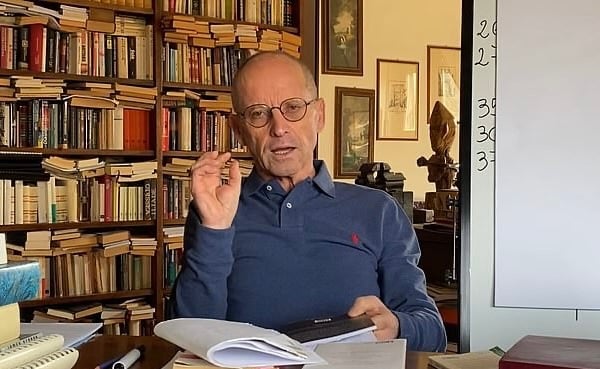
Mauro Biglino, a former biblical translator, says his career translating scripture for a Catholic publishing house came to an abrupt end after he began arguing that the Hebrew word “Elohim” — used 2,570 times in the Bible — refers not to a single God, but to a group of technologically advanced, mortal beings.
An Italian translator who spent roughly a decade working on the Old Testament for a publisher with links to the Vatican says his career there ended the moment he began sharing what he believed the original Hebrew text actually said. Mauro Biglino, who translated 17 books of the Old Testament for Edizioni San Paolo, argues that the word “Elohim” — rendered as “God” throughout most modern Bibles — should instead be understood as “Gods,” describing a group of mortal, technologically advanced beings rather than a single supreme deity. Speaking on the podcast Project Unity, hosted by Jay Anderson, Biglino said the reaction to his findings was swift: “When I started to write what I really read in the Hebrew Bible, I was fired in one minute.”
A career built on literal translation
Biglino’s interpretation, he says, rests on translating the Hebrew Bible literally, rather than filtering it through centuries of accumulated theological tradition. He argues that many of scripture’s most familiar passages have been reworked by later religious interpretation in ways that obscure what their original authors intended to convey. Central to this argument is the treatment of “Elohim” itself, which he notes is grammatically plural despite being routinely translated as a singular name for God. “There are multiple divine figures, with different names of God,” he said. “If Elohim are not God, the Bible is another Book.”
In his book Gods of the Bible, Biglino writes that specialist editions of the text often leave “Elohim” untranslated precisely because its meaning is contested, unlike mainstream Bibles, which render it simply as “God”. “Where people read ‘God’ and were led to believe that the biblical authors had written the word ‘God,’ scholars read the untranslated term ‘Elohim’ and were made aware that this term is problematic,” he wrote. He points to Hebrew dictionaries offering a far wider range of possible meanings for the word, including “gods,” “judges,” “rulers,” “superhuman beings,” “angels,” “children of God” and “those from above” — and notes that the term appears with both singular and plural verbs throughout the Old Testament, which he argues undermines the case for a single, consistent deity.
Biglino has also pointed to Genesis 1:26, in which God says “Let us make mankind in our image,” as further evidence that multiple beings were involved in humanity’s creation. He separately argues that the Hebrew word “kavod” — usually translated as “glory” in descriptions of God’s presence — originally referred to a physical, visible object rather than a purely spiritual concept.
Not spirits, but ‘flesh and blood’
Rather than treating the Elohim as supernatural or spiritual beings, Biglino describes them as physical entities who simply possessed longer lifespans and superior technology than humans. “The Elohim were flesh and blood, but with a longer lifespan, but still mortal, with higher technology and higher powers,” he told Anderson.
He points to Psalm 82 as a key piece of supporting evidence, a passage in which God is described standing among other divine beings before declaring: “You are ‘gods’; you are all sons of the Most High. But you will die like mere mortals; you will fall like every other ruler.” For Biglino, this describes a gathering of the Elohim rather than the pronouncements of a single, all-powerful God — a reading he says points to a council of powerful beings rather than one supreme ruler. Notably, the late biblical scholar Michael S. Heiser also interpreted Psalm 82 as describing a divine council, though Heiser regarded its members as spiritual beings rather than extraterrestrials.
Ezekiel’s wheels reinterpreted as technology
Biglino extends this reasoning to other parts of the Old Testament, arguing that passages long regarded as supernatural visions may in fact be eyewitness descriptions of advanced technology, described using the limited vocabulary available to ancient authors. His best-known example is the Book of Ezekiel, which describes “wheels one inside the other” that “moved in every direction without moving.” Where mainstream scholars read this as a symbolic vision of divine glory, Biglino believes the prophet was attempting to describe a craft.
Central to this reading is his interpretation of the Hebrew word “ruah”, which he says carried a concrete meaning in ancient usage. “The ancient Hebrew term ‘ruah’ had a very concrete meaning, as it stood for ‘wind,’ ‘breath,’ ‘moving air,’ ‘storm wind,’ and thus, in a broader sense, for ‘that which moves swiftly through the air space,'” he said. He argues that later theological tradition transformed this term into “spirit”, obscuring what he believes was originally a literal description of something moving rapidly through the sky. In his account, Ezekiel was recording a genuine historical event rather than a mystical experience. “We have a description of a very close encounter with an unidentified object that was undoubtedly in the air,” he wrote. “It looked like a thundercloud coming from the north; in its center, the prophet saw a fire (a propulsion system?) rotating around itself, like luminous radiation.”
Links to the ancient astronaut theory
Biglino’s work builds on the ancient astronaut hypothesis, a theory popularised by Swiss author Erich von Däniken in his 1968 bestseller Chariots of the Gods, which argued that extraterrestrials visited early human civilisations and shared advanced technology with them. The two authors collaborated before von Däniken’s death earlier this year, co-writing the book Skies Aflame. However, their approaches differ significantly: while von Däniken’s work focused on archaeological sites such as the Egyptian pyramids, Biglino bases his conclusions specifically on his own translations of the Hebrew Bible, arguing that key terms have been misunderstood for centuries.
Biglino has published several books setting out his interpretations, including Gods of the Bible, The Book That Will Forever Change Our Ideas About the Bible, and The Naked Bible, all of which have been translated into multiple languages and have built a substantial international following among supporters of the ancient astronaut theory. He maintains he was never formally excommunicated by the Catholic Church, but says his professional relationship with Edizioni San Paolo ended once he began publishing his literal readings of the Hebrew text.
Mainstream scholars push back
Biglino’s theory has not been accepted by mainstream biblical scholarship. While many scholars agree that “Elohim” is grammatically plural, they argue it commonly functions as a “plural of majesty” — a grammatical convention referring to the singular God of Israel rather than to multiple deities. Scholars also note that Hebrew frequently uses plural noun forms in ways that do not necessarily indicate multiple beings, pointing out that “Elohim” can take singular verbs when referring specifically to Israel’s God, depending on context.
Some biblical scholars, including Michael S. Heiser before his death, did accept that passages such as Psalm 82 describe a divine council of some kind. However, Heiser maintained that these beings were spiritual rather than extraterrestrial in nature, and said there was no evidence that the Bible’s authors intended to describe alien beings. More broadly, the ancient astronaut hypothesis continues to be widely rejected by archaeologists, historians and biblical scholars, who say there is no credible scientific or historical evidence that extraterrestrials shaped either the writing of the Bible or the development of ancient civilisations.
