

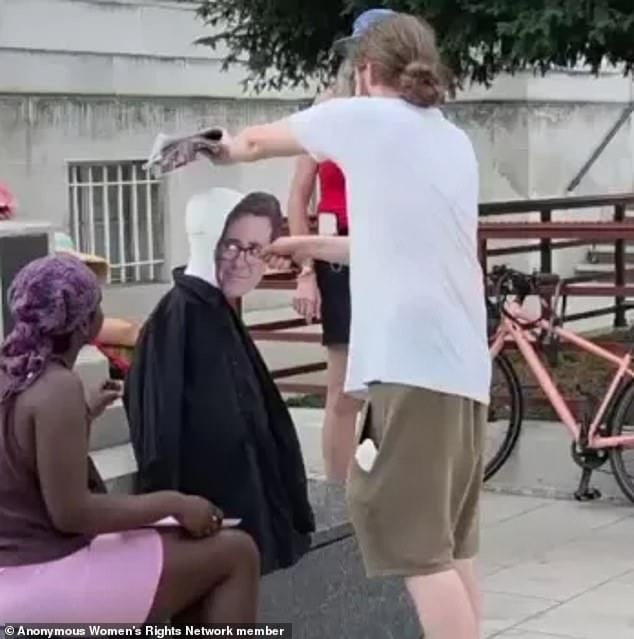
Four Green Party councillors, including three Hackney Council cabinet members, attended a pro-trans rally outside the borough’s town hall where protesters stabbed an effigy of incoming Prime Minister Andy Burnham with darts. The demonstration took place on 9 July, the same day police discovered the body of former Conservative minister Ann Widdecombe at her Devon home, though her death was not made public until the following day.
The protest, held outside Hackney Town Hall in East London, was organised to press the council into refusing to implement guidance from the Equality and Human Rights Commission on single-sex spaces, which states that transgender people should use facilities aligned with their birth sex. Video footage from the demonstration showed protesters striking an effigy of Burnham, the Makerfield MP due to succeed Sir Keir Starmer as prime minister on Monday, with darts. There is no suggestion that any of the attending councillors took part in or encouraged the act.
Who attended and why
The four councillors present were Florence Schechter, a Green cabinet member who founded and previously ran the Vagina Museum; fellow cabinet members Laura-Louise Fairley and Alastair Binnie-Lubbock; and Councillor Jas Crowe. Hackney is currently controlled by the Green Party, which won power in the borough in May’s local elections under leader Zack Polanski. A spokesperson for the Hackney Green Group told the Times that councillors attended the rally to show solidarity with the transgender community. “A number of Green councillors attended the event in order to reiterate their solidarity with the trans community, including holding a minute silence for transgender people who have lost their lives due to societal prejudice and violence,” the spokesperson said. They added that the EHRC’s revised guidance “works to segregate trans people from public life, exposes them to risk and makes unfeasible asks of businesses, services, and public bodies,” and stressed that “any protest involves various organisations and individuals. There is no collective responsibility for each attendee to account for the actions of other attendees.”

Political reaction to the timing
The proximity between the rally and Widdecombe’s death has drawn sharp criticism. Deputy Prime Minister David Lammy pointed to the timing directly, saying: “It is a shared responsibility of all of us in our democracy to call out and condemn violence and threats against politicians. I hope the Green Party leadership takes appropriate action this time.” Heather Binning, from the Women’s Rights Network, was more pointed in her criticism of the councillors’ conduct. “What is genuinely shocking is that Green Party councillors neither intervened to stop, nor have since condemned, a stunt that simulated violence against a politician, even when asked directly to comment on the incident,” she said. “This raises serious questions about whether politicians who oppose women’s rights to single-sex services and spaces in the name of so-called ‘trans rights’ can be trusted to uphold standards of open and healthy debate which underpin our democracy. Frankly it calls into question their basic decency – and in the context of recent events is all the more disturbing.”
Part of a wider wave of protests
Burnham himself has said the “time has come” to implement the EHRC’s guidance, which is based on a landmark Supreme Court ruling on the legal definition of biological sex handed down last year. The Hackney demonstration was one of at least 13 held across the UK in opposition to the EHRC’s revised Code of Practice, which was updated in full in May for the first time since 2011. The code covers nine protected characteristics, including sex and gender reassignment, and is intended to guide businesses and public bodies such as leisure centres and hospitals on how to comply with equality law when providing single and separate-sex services, including toilets and changing rooms.
A guidance document that has split opinion
The updated guidance confirms that single-sex services must be provided on the basis of biological sex rather than gender identity, a position that has been welcomed by women’s rights campaigners but criticised by a number of transgender rights groups, some of which have branded its contents “exclusionary.”
