

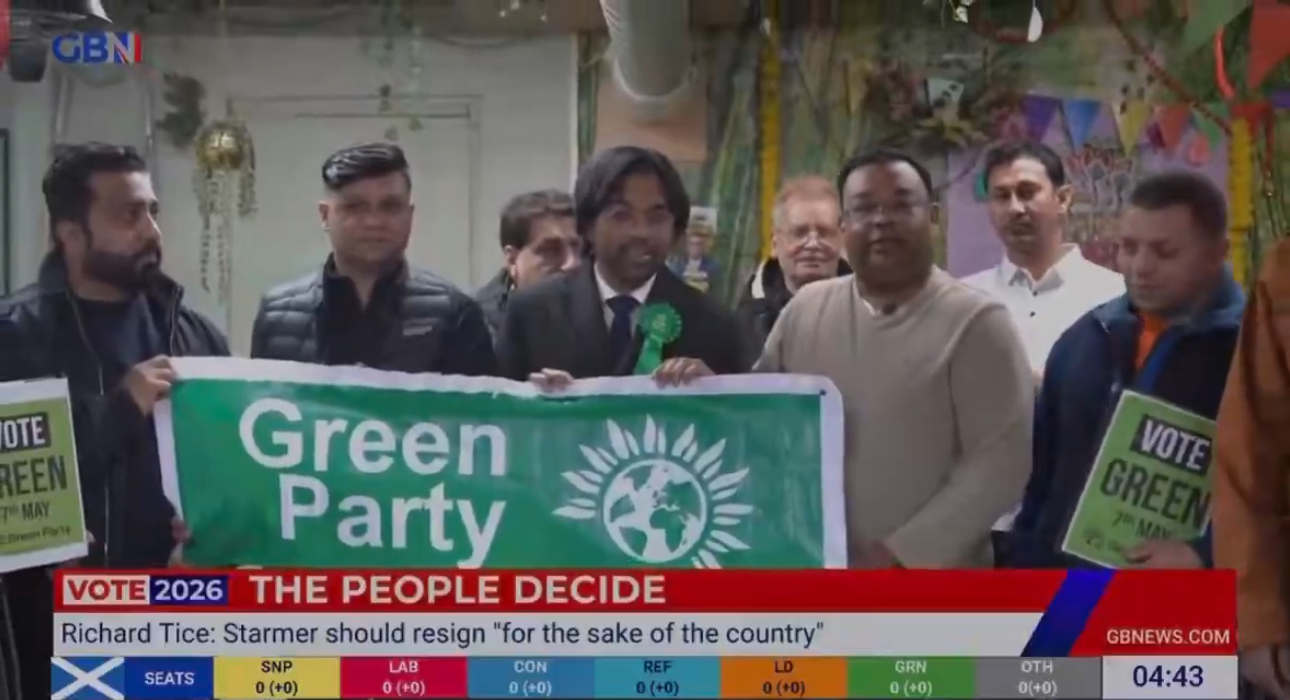
Green Party candidates who won seats in the UK local elections have delivered victory speeches in non-English languages, with footage showing newly elected councillors addressing supporters primarily in Bengali and opening with the Arabic greeting “As-salamu alaykum” — meaning “peace be upon you” — in what has sparked fresh debate about identity politics and integration in British public life.
The scenes, captured in Newham, east London — home to one of the largest Bangladeshi-origin communities in the country — show a newly elected Green councillor greeting supporters in Arabic before switching to Bengali to address what he described as “our Bangladesh community.” The group behind him held a large Green Party banner, with supporters carrying Vote Green signs, as part of what was branded Vote 2026 coverage.
While no law prevents elected officials from speaking in any language they choose, the footage has attracted significant attention and criticism given that UK local government business, council meetings and public announcements are conducted in English. Critics have argued that a victory speech largely inaccessible to non-Bengali speakers represents a departure from the expectation that English serves as the common public language in civic life.
The incident is not without precedent within the Green Party. In 2024, British-Bangladeshi Green councillor Mothin Ali — now a party co-deputy leader — won in Leeds’ Gipton and Harehills ward and shouted “Allahu Akbar” during his victory speech, dedicating the win to Gaza and Palestine while supporters waved a Palestinian flag. Ali’s election was widely seen as a watershed moment in the Greens’ strategy of courting Muslim voters disenchanted with Labour over its handling of the Gaza conflict.
That strategy appears to be bearing fruit in specific areas. The Green Party has continued to make gains in constituencies with large South Asian Muslim populations, and has deployed campaign materials in Urdu, Bengali and Arabic in targeted wards. Supporters of the approach describe it as inclusive representation that reflects the communities being served. Critics, however, have characterised it as sectarian electioneering that prioritises identity politics over the party’s traditional environmental platform.
The broader political context is significant. Since 2024, the Greens have increasingly positioned themselves as a protest vehicle for communities motivated by Gaza, anti-Islamophobia messaging and dissatisfaction with both Labour and Reform UK — a shift that has reshaped the party’s electoral coalition in ways that are now visibly playing out on election night.
