

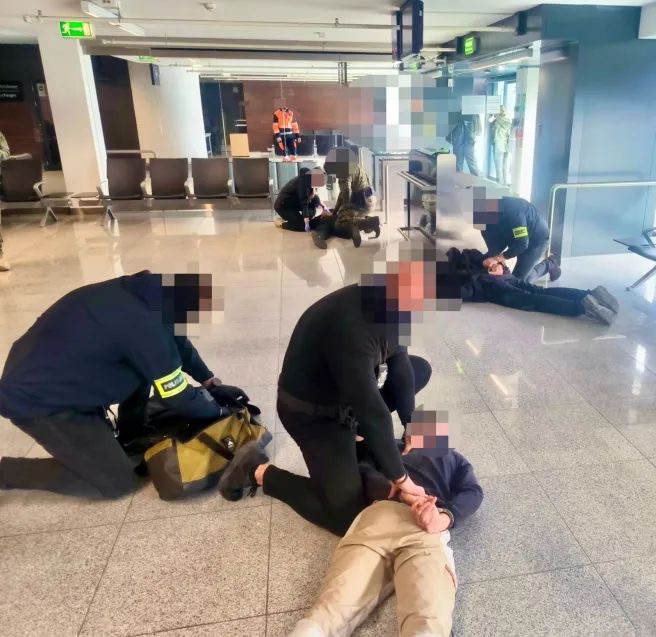
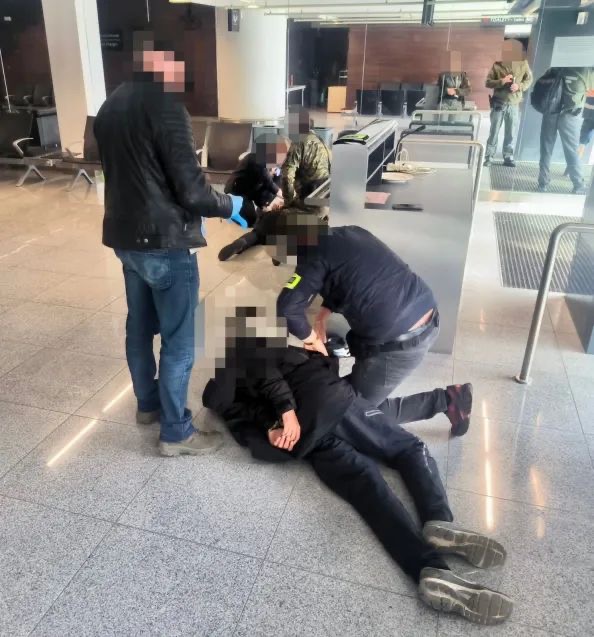
Polish police have arrested four Swedish citizens who allegedly robbed a Norwegian tourist at knifepoint in the historic centre of Gdańsk, detaining them at the city’s airport the following day as they prepared to board a flight back to Sweden.
The robbery took place on Stągiewna Street on 7 May 2026. The suspects — Mohamad H., 17, Aran Acib A., 23, Jabril H., 18, and Senal Saned O., 19 — allegedly held a knife to the victim’s chest while taking his mobile phone, bank card and PIN. They subsequently used the card to withdraw several thousand Norwegian kroner from ATMs and make purchases at shops before attempting to leave the country.
Officers from Gdańsk Police tracked the group to Lech Wałęsa Airport on 8 May, where they were detained while waiting for a flight to Gothenburg. All four were charged the following day with armed robbery committed in concert — an offence carrying a maximum sentence of 20 years under Polish law. A court ordered three months of pretrial detention for each suspect. All four pleaded not guilty during questioning. One of the suspects, Aran Acib A., is reported by local commentators to have a prior conviction for violent crime in Sweden.
Polish authorities described a swift and coordinated response, with Gdańsk police — accustomed to protecting one of Poland’s most popular tourist destinations for Scandinavian visitors — moving quickly to identify and intercept the group before they could leave Polish jurisdiction.
The case has attracted significant attention across social media and European news outlets, with much of the debate focusing not on the crime itself but on the suspects’ Swedish citizenship and the questions it raises about integration and the free movement of people within the Schengen area. Sweden has experienced a well-documented rise in gang-related violence in recent years, with official statistics from the Swedish Crime Prevention Council showing foreign-born individuals and their descendants significantly overrepresented in violent crime figures. Critics have pointed to this case as an example of how integration failures in one EU country can export consequences to others, with holders of EU passports able to travel freely across borders regardless of criminal history.
Poland, which maintained significantly stricter migration controls following the 2015 European migration crisis, records one of the lowest violent crime rates on the continent. The efficiency of the Gdańsk arrest has been widely noted as a contrast to the handling of similar cases elsewhere in Europe.
The Polish prosecutor’s office has made no comment on the suspects’ backgrounds or origins, focusing solely on the facts of the alleged offence.
