

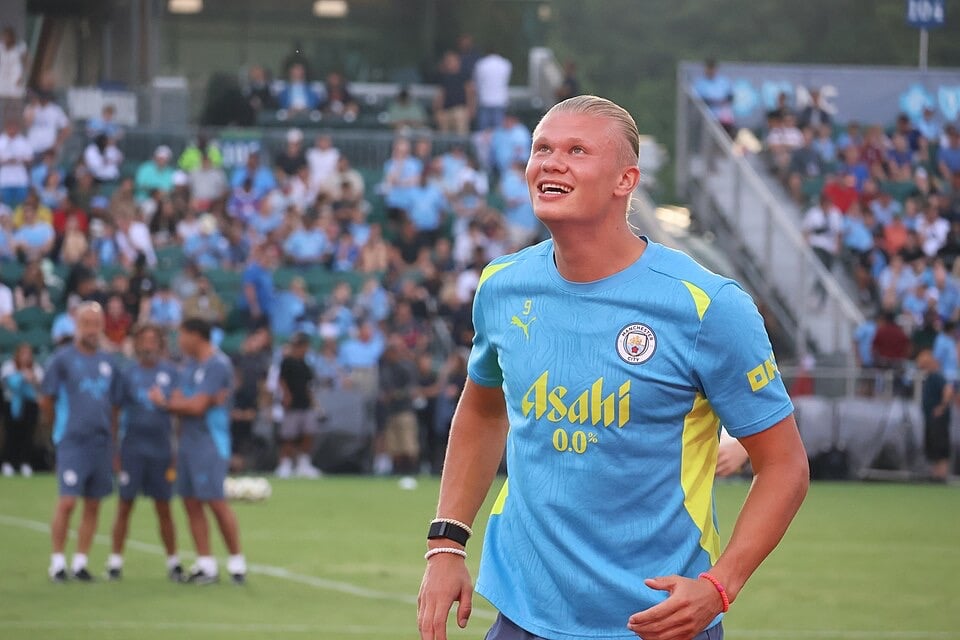
Erling Haaland is facing criticism in his home country after agreeing to front a major Budweiser advertising campaign ahead of this summer’s World Cup, with Norwegian health campaigners describing his decision to promote alcohol as “tragic” given his status as a role model for young people across the country.
The Manchester City and Norway striker has partnered with the American beer brand for its “Let It Pour” promotional campaign, which also features former Liverpool manager Jürgen Klopp. The campaign is being launched across 40 countries — but not in Norway, where all forms of alcohol advertising have been strictly banned since 1975 under the Alcohol Act. The legislation prohibits the promotion of beverages with an alcohol content of 2.5 per cent or higher across all media, including online and social media, and encompasses sponsorship of sporting events.
Haaland said in a press release accompanying the launch: “In my first World Cup, I’m going to give it my all on the pitch, so Budweiser’s Let It Pour campaign really resonates with me because it reflects exactly how I feel about the tournament.” The collaboration, while legal in the markets where it is being promoted, has provoked a fierce response from Norwegian public health bodies.
Inger Lise Hansen of Actis, an umbrella organisation working on drug policy and prevention, told Dagbladet she found the partnership deeply inconsistent with the values Haaland presents publicly. “That someone who is concerned about health — which I feel Haaland is — chooses to be a marketing object for an alcohol brand is very special,” she said. “This is not about people not being allowed to drink beer when they watch a football match, but that it is our sports hero who is helping to advertise a product that leads to injuries and risks.”
Hanne Cecilie Widnes of IOGT, a voluntary drug prevention organisation, was more direct in her criticism, focusing specifically on Haaland’s influence over younger audiences. “I wish the Norwegian FA could put a stop to it. It is tragic that Haaland does not see how negative it is for children and young people. He is a great hero for many young people in many countries. It is challenging and very sad.” Widnes called on the Norwegian football federation to “put its foot down,” describing the partnership as “very problematic.”
The Norwegian Football Federation took a measured position, defending Haaland’s legal right to enter into a personal commercial arrangement with one of FIFA’s largest World Cup sponsors while noting that the campaign would not extend to Norway. Runar Pahr Andresen of the NFF said: “Haaland has entered into a personal agreement with one of FIFA’s largest World Cup sponsors, which he naturally has the opportunity to do. Since alcohol advertising is illegal in Norway, we as a federation cannot of course enter into agreements with beer producers in the Norwegian market. Budweiser is a global and longstanding sponsor of FIFA, and is fully entitled to market its products in countries where such marketing is legal.”
Norway’s advertising ban, one of the most comprehensive in the world, covers all media including internet and social media and extends to zero-alcohol products that share branding with alcoholic drinks. The Norwegian Directorate of Health has the power to impose financial penalties on businesses and influencers who breach the restrictions. Since its introduction five decades ago, the ban is credited with reducing total alcohol sales in the country by approximately 7.4 per cent.
Budweiser is an official FIFA World Cup sponsor and the campaign’s global reach makes Haaland’s involvement significant beyond the Norwegian debate. The striker, preparing for his first major international tournament this summer, has not responded publicly to the criticism from his home country.
