

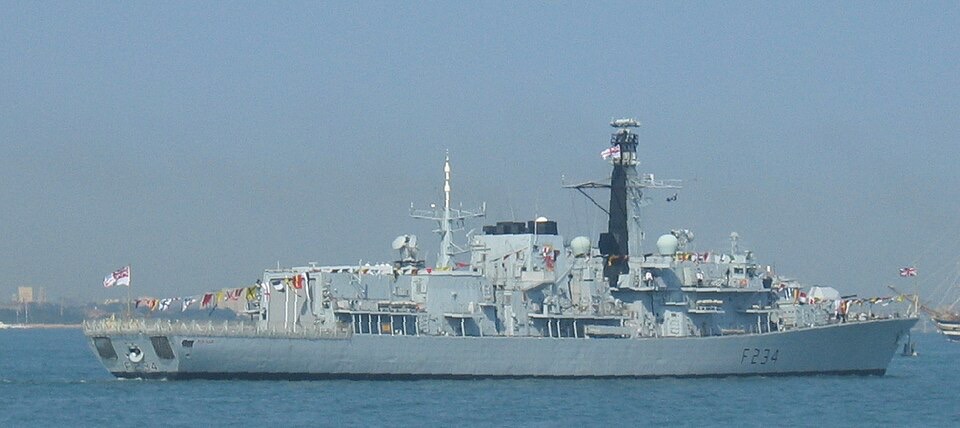
Britain’s Royal Navy has been left with just five active frigates after HMS Iron Duke was quietly withdrawn from service despite a £103 million refit completed only two years ago that was supposed to extend its operational life until 2028, raising serious questions about the country’s naval readiness at a time of mounting threats from Russia and ongoing conflict in the Middle East.
The Type 23 frigate has been stripped of its weapons and sensors and has not put to sea since October, according to Navy Lookout, which first reported the withdrawal. The outlet calculated that following the almost five-year refit — the most complex ever undertaken on a Type 23 frigate — Iron Duke had achieved a maximum of just 16 months of full operational availability, meaning the taxpayer effectively paid approximately £6.4 million for every month the ship was actually at sea, before running costs are even factored in.
The reasons behind the decision have not been officially confirmed, with speculation pointing to corrosion of the keel, propulsion problems or staff shortages making further investment difficult to justify given the vessel’s expected decommissioning in 2028. The ship is now considered unlikely to return to sea in any meaningful capacity before that date.
The timing could hardly be worse. The Royal Navy is already operating under severe strain. Russian submarines have brazenly entered British waters in recent months, while Moscow’s sanctioned vessels have passed through the English Channel unchallenged. General Sir Gwyn Jenkins, the First Sea Lord, recently warned that the threat posed by Russia to Britain would only “worsen further in future.” The Iran war has added further pressure, with questions raised about war-readiness following the delayed deployment of HMS Dragon to Cyprus after the UK’s sovereign base came under attack.
Iron Duke’s withdrawal has left the Navy’s already limited resources for monitoring Russian activity in the Channel even more stretched. It also means the service is now unable to assign more than a single frigate to its Carrier Strike Group — half the minimum number that would previously have been considered standard for such a deployment. The remaining five active frigates are largely committed to monitoring potential submarine activity in the North Atlantic, leaving almost nothing in reserve.
The frigate had a distinguished recent history despite its troubled refit. It hosted a reception for King Charles and Queen Camilla in Bordeaux during the King’s state visit to France, escorted a Russian frigate through the English Channel in 2024 and was used to shadow the Russian spy ship Yantar. It also hosted the Prince of Wales during a £40 million drug seizure operation in the Caribbean in 2008, when he was serving as a 26-year-old sub-lieutenant.
Iron Duke began its refit at Devonport in May 2019, having sat in Portsmouth since 2017 due to severe corrosion of the hull. The work was completed in 2023 and was intended to give the ship at least five further years of operational life.
The Duke-class Type 23 frigates are in the process of being replaced by the newer Type 26, though when those vessels will enter service remains unclear. The final batch of Type 23s was ordered in 1996 with an intended lifespan of 18 years. Successive governments failed to order replacements until 2017 — a decision that defence analysts have consistently identified as one of the most consequential failures of British defence procurement in a generation.
