

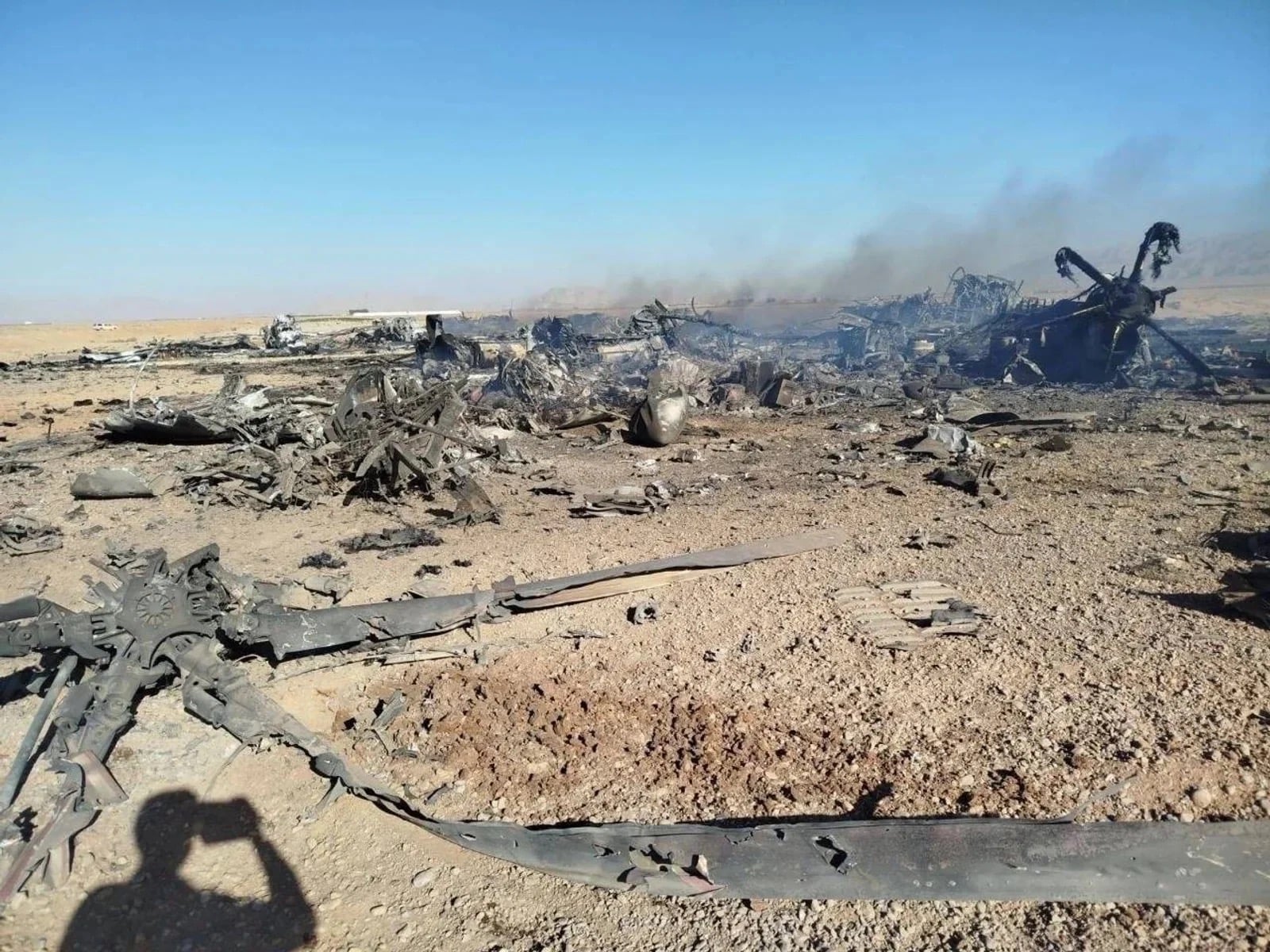
Iran has released images purporting to show the destroyed remains of multiple American aircraft following a high-risk rescue operation that extracted a downed US airman from deep within Iranian territory, raising questions about the full cost of a mission President Donald Trump hailed as one of the most daring in military history. The wreckage, appearing to include at least one large propeller transport plane and a helicopter, lies approximately 28 miles south of Isfahan, a strategic hub for the Islamic Revolutionary Guard.
US officials confirmed that special forces were forced to intentionally destroy aircraft that encountered technical difficulties during the successful extraction of an F-15 weapons officer who had been evading Iranian forces in mountainous terrain. President Trump announced the mission’s success on Truth Social this morning, declaring “WE GOT HIM!” whilst confirming no American military personnel were killed or injured during the operation, despite what he described as a “harrowing and massively dangerous” mission into hostile territory.
Trump’s triumphant announcement amid conflicting wreckage claims
The President framed the rescue in heroic terms, writing on his Truth Social platform: “My fellow Americans, over the past several hours, the United States Military pulled off one of the most daring Search and Rescue Operations in US history, for one of our incredible crew member officers.”
Mr Trump described how the airman “was behind enemy lines in the treacherous mountains of Iran, being hunted down by our enemies, who were getting closer and closer by the hour, but was never truly alone because his Commander in Chief, Secretary of War, Chairman of the Joint Chiefs of Staff, and fellow warfighters were monitoring his location 24 hours a day, and diligently planning for his rescue.”
The President confirmed the rescued weapons officer had sustained injuries from the initial crash but “will be just fine.” He also claimed this represented “the first time in military memory that two US pilots have been rescued, separately, deep in enemy territory,” emphasising his administration’s commitment: “WE WILL NEVER LEAVE AN AMERICAN WARFIGHTER BEHIND!”
However, the triumphant tone contrasts with the material losses revealed by Iranian state media footage. The regime has claimed it shot down two American C-130 transport aircraft and two Blackhawk helicopters during the mission, though US sources acknowledge only that at least one transport plane was intentionally destroyed by ground troops after encountering technical difficulties, with all personnel successfully evacuated before detonation.
The cause of the wrecks has not been independently verified, leaving open whether Iran’s air defences downed additional aircraft or whether all wreckage resulted from US forces destroying equipment they could not recover to prevent it falling into enemy hands.
How pararescue teams extracted a hunted airman from Iran’s interior
The weapons officer became separated from his aircraft’s pilot when their F-15E fighter jet was shot down by Iranian forces earlier in the week. Elite Air Force pararescue units successfully extracted the pilot on Friday, but the weapons officer remained behind enemy lines, reportedly evading Iranian search teams in the mountainous terrain of Khuzestan province.
Pararescue jumpers, among the most highly trained special operations forces in the American military, led the recovery effort that culminated in Saturday morning’s extraction. These specialist units, known colloquially as PJs, undergo years of training in combat medicine, survival techniques, and high-risk insertion methods, making them uniquely qualified for missions deep into hostile territory.
The operation required penetrating approximately 28 miles into Iranian-controlled territory to reach the area south of Isfahan where the airman was located. Isfahan hosts significant military infrastructure operated by the Islamic Revolutionary Guard Corps, making any US military presence in the vicinity extraordinarily dangerous and likely to trigger immediate armed response.
US officials speaking to Reuters and the Associated Press confirmed that technical difficulties with aircraft during the mission forced ground troops to make the difficult decision to destroy at least one transport plane rather than allow it to be captured. The decision to blow up American military equipment on Iranian soil represents a significant acknowledgment of the operational challenges encountered, even as the primary mission succeeded in recovering the downed airman.
The nature of the “technical difficulties” has not been specified, though such problems during special operations can range from mechanical failures and enemy fire damage to unsuitable terrain for extraction preventing aircraft from landing or hovering safely for personnel recovery.
The strategic gamble of deep penetration rescue missions
The decision to mount a rescue operation 28 miles inside Iranian territory, in proximity to a major IRGC hub, reflects both the political imperative of recovering downed aircrew and the military calculation that abandoning personnel would damage morale and potentially provide Iran with valuable intelligence from interrogation.
President Trump’s emphasis on never leaving American warfighters behind echoes long-standing military culture that prioritises personnel recovery even at substantial risk and cost. This ethos, while celebrated domestically, creates predictable patterns that adversaries can exploit, potentially setting ambushes or concentrating defences around downed aircraft.
The loss of transport aircraft and potentially helicopters during the rescue represents a significant material cost beyond the original F-15 loss. Each C-130 transport aircraft costs approximately $70 million, whilst Blackhawk helicopters run roughly $20 million per unit. If Iran’s claims of shooting down two of each prove accurate, the financial cost would exceed $180 million in destroyed aircraft, though US sources have not confirmed these figures.
Beyond financial considerations, the wreckage provides Iran with intelligence opportunities. Even destroyed aircraft contain components, communications equipment, and design features that adversaries can study. The decision to intentionally destroy equipment before evacuation suggests US forces prioritised denying Iran intact systems, though debris analysis can still yield valuable information.
The rescue’s success also demonstrates American willingness and capability to conduct high-risk special operations deep inside Iranian territory, a signal that may factor into Tehran’s calculations about the vulnerability of its interior regions to US military action. Conversely, Iran’s ability to down the original F-15 and potentially damage or destroy rescue aircraft demonstrates its air defence capabilities remain formidable despite ongoing US strikes.
Iran’s propaganda victory amid operational failure
Iranian state media’s release of wreckage footage serves domestic and international propaganda purposes, even as the underlying mission – preventing the airman’s rescue – failed. The images of destroyed American aircraft allow the regime to portray successful defence of Iranian airspace and exact a cost for US military operations.
The wreckage site’s location near Isfahan carries symbolic weight. The city hosts significant nuclear facilities and military production complexes, making it strategically vital to Iran’s defence infrastructure. Forcing the US to abandon or destroy aircraft in this region allows Iran to claim it successfully defended sensitive areas against American penetration.
However, the propaganda value is limited by the rescue’s success. Despite whatever losses US forces sustained in aircraft, they achieved their primary objective of recovering the downed airman, denying Iran either a prisoner or the intelligence that interrogation might provide. The decision to destroy equipment rather than abandon it intact further limits the intelligence value Iran can extract from the wreckage.
The regime’s claims of shooting down two C-130s and two Blackhawks may be exaggerated, though the presence of substantial wreckage confirms significant US losses beyond the acknowledged intentional destruction of one transport plane. Distinguishing between aircraft downed by enemy fire and those destroyed by US forces to prevent capture will require independent verification that may not be forthcoming.
The broader Iran conflict and the human cost calculation
The rescue operation occurs within the context of escalating military confrontation between the United States and Iran, triggered by joint US-Israeli strikes in late February. The F-15 loss that necessitated the rescue represents the most significant American combat aircraft loss in the conflict thus far, whilst the subsequent rescue mission’s difficulties underscore the operational challenges of sustained military operations against a capable adversary.
President Trump’s characterisation of the mission as uniting all Americans “Republican, Democrat, and everyone else” in pride attempts to rally domestic support for what has become an increasingly contentious military engagement. His declaration that “we truly have the best, most professional, and lethal military in the history of the world” celebrates military capability whilst glossing over the mounting costs in aircraft and the risk to personnel.
The former officer’s description of the mission as “harrowing and massively dangerous” in “grave terms” provides a counterpoint to the triumphant presidential rhetoric, acknowledging the genuine peril faced by rescue forces penetrating deep into hostile territory against a determined adversary with sophisticated air defences.
The successful recovery of both F-15 crew members represents a tactical victory for US special operations forces and validates the extensive training and resources invested in personnel recovery capabilities. However, the apparent loss of multiple aircraft during the rescue mission raises questions about whether the cost-benefit analysis of such operations remains sustainable if the conflict continues and additional aircrew require extraction from Iranian territory.
Iranian forces’ ability to shoot down advanced US combat aircraft and contest rescue operations suggests the conflict has evolved beyond the initial strikes into something approaching conventional warfare between near-peer adversaries. The United States maintains overwhelming military advantages in most categories, yet Iran’s ability to impose costs through air defences, asymmetric tactics, and geographic advantages in its own territory creates operational challenges that pure technological superiority cannot entirely overcome.
