

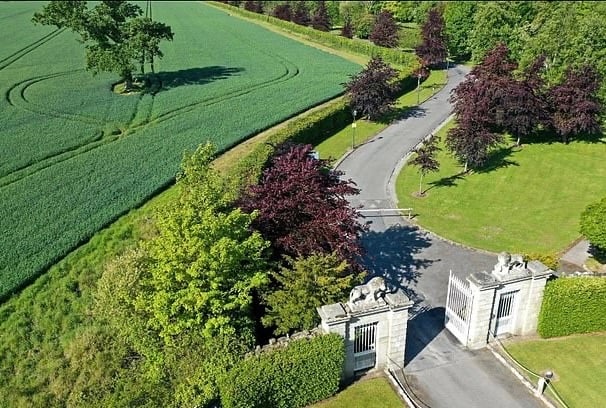
A meticulously reconstructed 18th-century mining settlement in County Kildare that survived industrial collapse, decades of abandonment, and two separate billionaire ownership periods has reached the international property market at €20 million (£17.5 million), presenting prospective buyers with an unusual proposition: a functioning five-star hotel operation wrapped inside an authentically preserved piece of Irish industrial archaeology.
The Village of Lyons—20 acres of Georgian stone cottages arranged in intimate squares connected by landscaped courtyards—represents an increasingly rare commodity in European heritage property markets: a complete historical settlement restored to commercial viability without sacrificing architectural integrity or spatial authenticity. The 47-bedroom hotel operation trading as Cliff Lyons generates revenue that justifies the extraordinary maintenance costs such properties demand, whilst preserving structures dating to the 1820s in conditions that conservation purists might struggle to achieve through museum-style preservation alone.
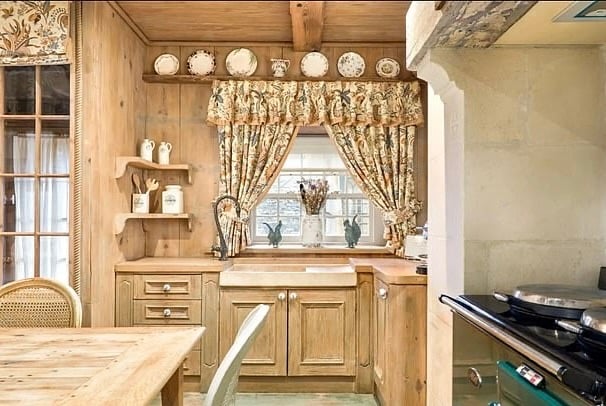
Current owner Barry O’Callaghan acquired the broader estate in 2016, inheriting a restoration vision executed during the 1990s by Tony Ryan—Ryanair’s co-founder whose aviation fortune funded the ambitious reconstruction that rescued Lyons from the dereliction that followed an 1887 catastrophe. Ryan died in 2007, with his personal estate house within the village remaining family-owned and excluded from the current sale—an arrangement creating the peculiar circumstance where the settlement’s animating historical figure maintains posthumous presence through relatives occupying the original manor whilst the restored village surrounding it transfers to new ownership.
David Byrne of Sotheby’s International Realty, which markets the property as “one of Ireland’s most remarkable private estate villages,” anticipates the eventual purchaser will “likely be an ultra-high-net-worth individual” viewing Lyons either as Irish country estate acquisition or investment vehicle exploiting established hospitality infrastructure positioned 30 minutes from Dublin yet accessible only through gated avenues preserving its secluded character.
What an 1887 Mill Fire Reveals About Industrial Settlement Vulnerability
The village’s historical trajectory illustrates how single industrial facilities determined settlement survival in pre-modern economies. Lyons developed during the 18th century as mining village, with the flourmill operated by Joseph P Shackleton—relative of renowned Antarctic explorer Ernest Shackleton—providing economic foundation supporting shops, schools, and residential development throughout the 1820s expansion that produced the Georgian cottages currently commanding luxury hospitality rates.
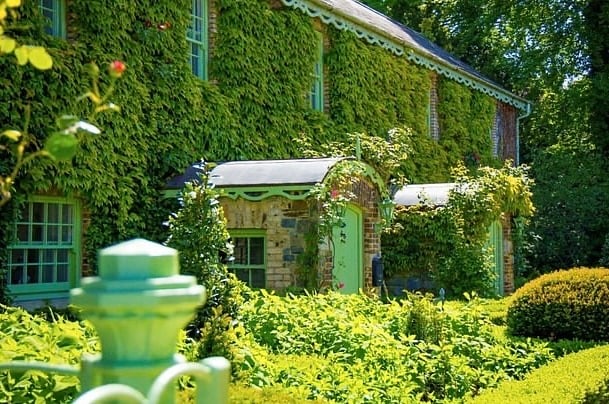
The mill’s conversion to roller operations in 1887 suggested adaptation to changing industrial technologies, yet the facility’s destruction by fire that same year eliminated the economic anchor sustaining the broader community. The cascading failures proved swift and comprehensive: the school shuttered, commercial premises ceased trading, and residential buildings entered extended neglect as families dependent on mill-related employment dispersed to locations offering viable livelihoods.
This pattern—single-industry settlements experiencing catastrophic decline when foundational enterprises collapse—repeated across industrialising Europe and North America during the 19th and early 20th centuries. Mining villages, mill towns, and railway settlements that thrived during expansion phases frequently became ghost communities when technological change, resource depletion, or economic shifts eliminated their raison d’être. Lyons’ subsequent resurrection through private wealth distinguishes it from thousands of comparable settlements that remained derelict or were demolished entirely.
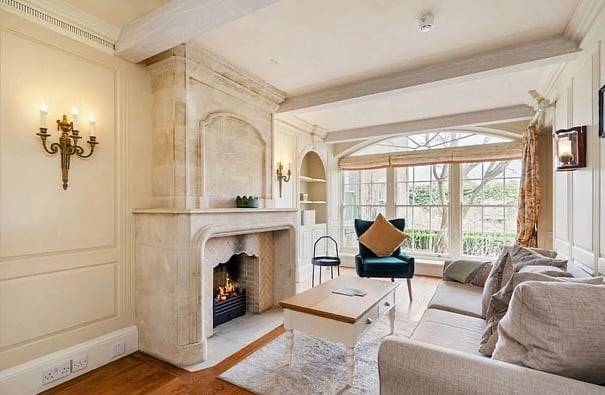
Tony Ryan’s 1990s intervention represented substantial capital deployment driven by motivations extending beyond pure financial return. Aviation fortunes generated during Ryanair’s transformation of European air travel funded reconstruction that Nicola Vance of Sotheby’s International Realty characterised as prioritising longevity over cost minimisation: “The buildings are so beautiful—they look like they have been there for hundreds of years despite being built in the Nineties. They were built with longevity in mind.”
The distinction matters because heritage reconstruction projects frequently balance authentic restoration against modern building standards, with compromises favouring either historical accuracy or contemporary functionality. Ryan’s approach apparently achieved synthesis: Georgian architectural vocabulary and spatial arrangements replicating 1820s village fabric, yet incorporating structural engineering, utilities infrastructure, and comfort standards enabling luxury hospitality operations that generate revenues justifying ongoing maintenance costs.
Why Commercial Viability Determines Heritage Preservation Success
The transformation from abandoned mining settlement to functioning five-star hotel operation demonstrates how commercial use can sustain heritage assets in ways that pure conservation funding struggles to replicate. Museum-style preservation depends on philanthropic support, government grants, or tourism revenues from visitors paying admission fees—funding streams subject to economic cycles, political priorities, and competition from alternative cultural attractions.
Operating heritage properties as luxury hospitality venues creates self-sustaining revenue models where guest payments cover maintenance, staffing, utilities, and property improvements whilst providing return on invested capital. The 47 bedrooms distributed across Lyons’ restored cottages generate income streams that pure preservation could never achieve, whilst the five-star positioning justifies premium rates that offset the extraordinary costs of maintaining 200-year-old structures to contemporary hospitality standards.
The village’s amenities reflect this commercial imperative: spa facilities, multiple dining venues including the Shackleton Mill Restaurant and Terrace occupying the rebuilt mill structure, entertainment spaces, and grounds featuring landscaped courtyards, orchards and waterways appeal to affluent guests seeking country estate experiences within convenient distance of Dublin’s commercial centre. Proximity to golf courses, country houses and working farms positions Lyons within Ireland’s established luxury tourism geography—a commercial ecosystem supporting multiple high-end properties through overlapping guest bases and coordinated marketing.
Yet commercial hospitality operations inevitably transform historical sites from lived communities into carefully curated experiences. The cottages housing Lyons’ original mining families and mill workers now accommodate transient guests paying premium rates for pastoral aesthetics and historical atmosphere—a conversion that preserves architectural fabric whilst fundamentally altering social function. The village exists as simulation of historical community rather than continuation of it, with rose-clad cottages and intimate squares serving contemporary leisure consumption rather than supporting industrial livelihoods.
This tension between preservation and commercialisation characterises heritage hospitality ventures globally. Authentic historical environments attract guests precisely because they differ from standardised hotel experiences, yet those environments require substantial ongoing investment that commercial operations alone can justify. The alternative—allowing structures to decay until public intervention occurs or demolition becomes necessary—eliminates heritage assets entirely rather than preserving them in altered form.
The Lyons sale at €20 million reflects both the capital required to acquire functioning luxury hospitality operations and the premium attached to properties offering authentic heritage credentials within convenient distance of major urban centres. Comparable estates without historical significance or those requiring substantial restoration investment would command lower valuations, whilst heritage properties lacking commercial viability struggle to attract buyers willing to assume ongoing maintenance obligations without corresponding revenue generation.
The listing’s emphasis on the site as “truly enchanting sanctuary” accessed through gated avenues highlights the exclusivity premium that drives luxury hospitality economics. Guests pay not merely for accommodation and amenities but for controlled access to environments offering respite from urban density—a commodity that gated heritage estates provide more convincingly than purpose-built resorts lacking authentic historical narratives.
Whether the eventual purchaser operates Lyons as continuing hospitality business, converts it to private estate, or pursues hybrid model combining personal use with commercial operations will determine the settlement’s trajectory for coming decades. Each scenario presents distinct preservation challenges: pure commercial operation maximises revenue whilst potentially prioritising guest experience over conservation authenticity; private estate conversion removes commercial pressures but depends entirely on owner commitment and resources; hybrid approaches attempt balance but introduce complexity around guest access, privacy preservation, and resource allocation between personal and commercial uses.
What remains certain is that Lyons’ survival as coherent historical settlement depends absolutely on continuing infusions of substantial capital—whether through hospitality revenues, private wealth, or some combination. The 1887 mill fire that triggered the original decline demonstrated how rapidly settlements collapse when economic foundations disappear; the subsequent century of neglect showed that historical significance alone provides insufficient protection; and Ryan’s 1990s restoration proved that private capital deployed with preservation priorities can resurrect communities that public resources abandoned. The €20 million price tag reflects not merely current asset value but the ongoing commitment required to prevent renewed decay of structures that survived industrial revolution, economic collapse, and extended abandonment only through extraordinary interventions by individuals whose wealth enabled what governments and institutions could not achieve.
